
Travis County Property Records
Travis County property records are maintained by the County Clerk in Austin, Texas, with real property documents dating back to 1840. The clerk's office records and indexes all deeds, mortgages, liens, plats, and other land instruments filed in the county. Online search is free through the official portal, and documents can be viewed without charge. This guide covers how to find and use Travis County property records, what agencies maintain them, and what fees and procedures apply.
Travis County Overview
Travis County Clerk Office
The Travis County Clerk is the official custodian of all real property records in the county. The main office is located at 5501 Airport Blvd in Austin. The clerk records and indexes deeds, deeds of trust, lien filings, deed releases, plats, oil and gas instruments, easements, assumed name certificates, and more. Records go back to 1840, making Travis County one of the most historically deep property archives in Texas.
Online search is available through the county's official public records portal at no cost. You can search by grantor or grantee name, document type, recording date range, instrument number, or book and page reference. The system covers over 60 document categories. Document images are free to view online. Certified copies require a direct request and cost $5.00 plus $1.00 per page. Plain uncertified copies cost less.

| County Clerk | Travis County Clerk's Office |
|---|---|
| Address | 5501 Airport Blvd, Austin, TX 78751 |
| Online Search | countyclerk.traviscountytx.gov |
| Hours | Monday through Friday, regular business hours |
| City Page | Austin Property Records |
Travis County covers Austin and surrounding areas with a population of about 1.3 million. The county clerk also processes birth and death certificates from 1903, marriage licenses from 1840, UCC filings, and federal tax liens. The property fraud alert service lets owners sign up for notifications when a document is recorded against their property name.
Search Travis County Property Records Online
The Travis County Clerk's online portal is the main tool for property records search. The system lets you search by grantor name, grantee name, document type, date range, instrument number, or legal description keywords. With over 60 document categories available, you can filter results to find exactly the type of instrument you need.
Search results show the document type, recording date, all party names, and the instrument number. Click into any result to view the document image for free. Online images are watermarked for viewing purposes. The portal covers records from the county's main index. Historical records from 1840 through approximately the early 1990s may be part of a separate historical index that the clerk can help you locate.

For in-person searches, visit the clerk's office at 5501 Airport Blvd. Public terminals are available for self-service searching during business hours. Staff can explain the search system, but under Texas AG Opinion WW-607, they cannot perform the actual search for you. Title companies regularly handle full title searches in Travis County if you want professional help.
Note: The Portal to Texas History has digitized some early Travis County deed records from 1840 to 1900, which are available with high-resolution scans through the portal's website as a supplemental research tool.
Types of Travis County Property Records
Travis County has one of the most active real estate markets in Texas. The County Clerk records a high volume of instruments each year. Every recorded document becomes part of the public record and provides constructive notice under Texas Property Code Section 12.001. That means once a deed or lien is filed, anyone dealing with that property is considered to have notice of it.
Common property record types filed in Travis County include general warranty deeds, special warranty deeds, quitclaim deeds, deeds of trust, releases of deeds of trust, mechanic's liens, materialman's liens, tax lien notices, federal tax lien notices, lien releases, easement instruments, right-of-way agreements, subdivision plat maps, oil and gas leases, surface use agreements, and assumed name certificates. UCC filings and fixture filings are also recorded at the county clerk level.
Plat maps in Travis County are critical for understanding subdivision boundaries, lot lines, easements, and right-of-way areas. The county has thousands of recorded plats covering developments from the 1800s through current new construction. You can request copies of plat maps directly from the clerk's office or view them through the online portal.
Under Texas Property Code Section 13.001, a recorded instrument is constructive notice of its contents from the date of filing. This rule protects buyers and lenders who rely on the public record to confirm what encumbrances exist on a property before closing.
Travis Central Appraisal District
The Travis Central Appraisal District (TCAD) maintains tax appraisal records for all property in Travis County. Chief Appraiser Marya Crigler oversees the appraisal of over 400,000 parcels. The TCAD database is searchable online by owner name, property address, account number, map ID, or legal description. Results show property characteristics, appraised value history, exemptions, and ownership.
The TCAD also provides interactive GIS maps showing parcel boundaries, aerial imagery, and nearby sales data. This map tool is useful for getting a visual sense of a property's location, size, and surrounding parcels. Comparable sales data is also available through the portal, which property owners use to evaluate whether their appraised value is fair before filing a protest.
Protest filing is available online through the TCAD portal. The annual protest deadline is May 15. After that date, you must appear before the Appraisal Review Board in person unless you have an extension. Exemption applications for homestead, over-65, disability, and other categories are also available on the TCAD site. These applications can significantly reduce your tax bill if you qualify.
Note: TCAD ownership records may lag by several months after a deed is recorded at the clerk's office, as the county updates the tax rolls during regular processing cycles.
Travis County Tax Office
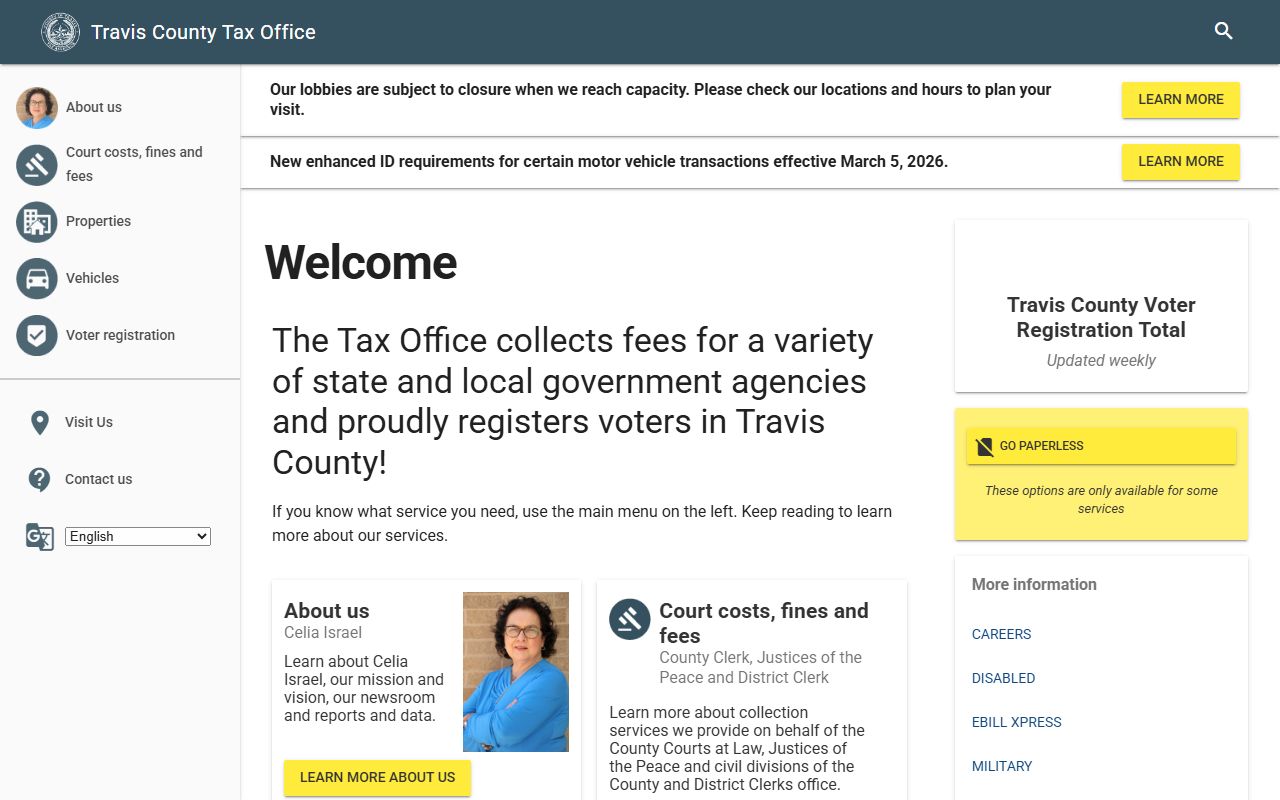
The Travis County Tax Office handles property tax collection for the county and all taxing entities within it. Tax bills are searchable online, and payments can be made through the portal. The tax office also provides tax certificates, which confirm whether taxes are current on a property. Tax certificates are often required in real estate closings.
If you have delinquent taxes, the tax office offers payment plans under certain circumstances. Over-65 and disabled homeowners may be eligible for deferrals that delay collection. Tax lien sales for delinquent properties are announced on the tax office website. The tax office also handles motor vehicle registration, voter registration services, and mobile home tax payments.
Recording Fees and eRecording
Recording a document with the Travis County Clerk costs $26 for the first page and $4.00 for each additional page. If a document lists more than five parties to be indexed, there is an extra $0.25 per additional name. These fees match the state standard and apply uniformly. The fee covers document imaging, indexing, and permanent storage in the official archive.
Travis County accepts documents by in-person submission at the Airport Blvd office, by mail with a check or money order, or through eRecording. eRecording vendors authorized for Travis County include Simplifile, CSC, and EPN. eRecording is available around the clock and is the standard method for title companies and lenders. Documents submitted electronically are typically returned as recorded originals on the same business day.
Copy fees vary by type. In-office plain copies cost $0.25 per page. Online viewing is free but watermarked. Email delivery of copies costs $1.00 per page. Certified copies require a $5.00 certification fee plus $1.00 per page. Mailed copies cost $1.00 per page plus actual postage. For standard title research, the free online viewing option is usually sufficient.
Texas Public Information Act
Travis County property records are open to the public under Texas Government Code Chapter 552, the Public Information Act. Anyone can look up, view, and copy recorded instruments without stating a reason. You do not need to own the property or be a party to the document to access it.
In practice, current property records are available immediately through the online portal without any formal request. For older documents or special requests, the clerk's office must respond within ten business days. If it will take longer, the office must notify you. The Texas Attorney General's Open Government Division handles disputes about access and publishes free guidance on your rights as a requestor.
Personal identifiers are redacted from online document images. Social security numbers and financial account numbers are removed from online views under Texas Property Code Section 11.008(k). The original paper record held by the clerk contains the complete information, but the online version shows blank spaces where those identifiers appeared. This rule protects individuals while keeping the property records public.
Additional Travis County Property Resources
The Texas Comptroller's Property Tax Assistance Division provides statewide guidance on exemptions, appraisal processes, and taxpayer rights. Austin and Travis County have seen rapid appreciation in recent years, and the Comptroller's office is a useful resource for understanding how appraisal caps and exemptions work to limit tax increases on your home.
The Texas General Land Office holds the original land grant records for Travis County going back to the Republic of Texas and earlier Spanish and Mexican periods. Austin itself was founded as the capital of the Republic, and the GLO database holds many of the earliest property instruments connected to this land. The database is free and searchable online.
The Texas Secretary of State's SOSDirect system covers UCC filings, fixture filings, and business entity records. In a large, active market like Austin, many property transactions involve entities like LLCs and corporations. The SOS system lets you verify the legal standing of those entities and look up UCC filings that might encumber business property.
The Texas State Law Library maintains free research guides on property law, recording requirements, and title issues. These guides are a solid starting point if you need to understand the legal rules behind Travis County property transactions.
Nearby Counties
Travis County is surrounded by several fast-growing counties in Central Texas. If a property sits near a county boundary, confirm the correct county before searching.