
Search Andrews County Property Records
Andrews County property records date back to 1881 and are maintained by the County Clerk in Andrews, Texas. These records include deeds, mortgages, oil and gas leases, mineral deeds, liens, and plat maps. This page covers the main offices and online tools you can use to find and obtain Andrews County property documents.
Andrews County Overview
Andrews County Clerk Office
The Andrews County Clerk is the official keeper of real property records in the county. Vicki Scott serves as County Clerk. The office is at 215 NW 1st Street, Ste. 121-A, Andrews, TX 79714, phone (432) 524-1426, fax (432) 524-1464. Hours are Monday through Friday, 8:00 AM to 5:00 PM.
Property records in the system go from 1881 through the present day. The archive is complete with no known major losses. Records are updated daily. Document types filed with the Andrews County Clerk include real property deeds and mortgages, oil and gas leases, mineral deeds, UCC filings, assumed name (DBA) certificates, liens, plats, probate records, and court records.
The Andrews County Clerk's online portal at andrewscountytx-web.tylerhost.net allows you to search by grantor or grantee name, document type, date range, legal description, or instrument number. Document images are available for download as PDFs. A watermarked preview is free; full downloads require a fee.

You can also search Andrews County records through TexasFile. The index search is free, and downloading document images is available on a per-page or subscription basis. Mail requests should be sent to: Andrews County Clerk, 215 NW 1st Street, Ste. 121-A, Andrews, TX 79714.
Oil and Gas Records in Andrews County
Andrews County sits in the Permian Basin, one of the most productive oil-producing regions in the world. This means the county's property records contain a large volume of mineral deeds, oil and gas leases, royalty assignments, and division orders. If you are researching mineral ownership or working through a lease chain of title, Andrews County has an especially deep archive of these documents.
Capitol Appraisal Group handles mineral valuations for Andrews County. Mineral interests are taxed separately from surface ownership, so you may need to search both the deed records and the appraisal district records to get a full picture of what a property's ownership structure looks like. Active drilling activity in the county means new leases and assignments are being filed regularly, so the records are updated often.
Under Texas Property Code Section 12.001, instruments must be recorded with the county clerk to be effective against third parties. This is especially important for oil and gas assignments and mineral conveyances, where competing claims on the same interest can arise. Texas Government Code Chapter 552 guarantees your right to access these public records.
Note: The Texas Secretary of State's SOSDirect at direct.sos.state.tx.us is worth checking if a party in a mineral transaction is a business entity, since UCC liens on business assets are filed there.
Andrews County Appraisal District
The Andrews County Appraisal District (ACAD) is responsible for appraising all real and personal property in the county for tax purposes. The office is at 600 N. Main St., Andrews, TX 79714, phone (432) 523-9111, fax (432) 523-3222. Susan Brewer serves as Chief Appraiser. Email: info@andrewscad.org.
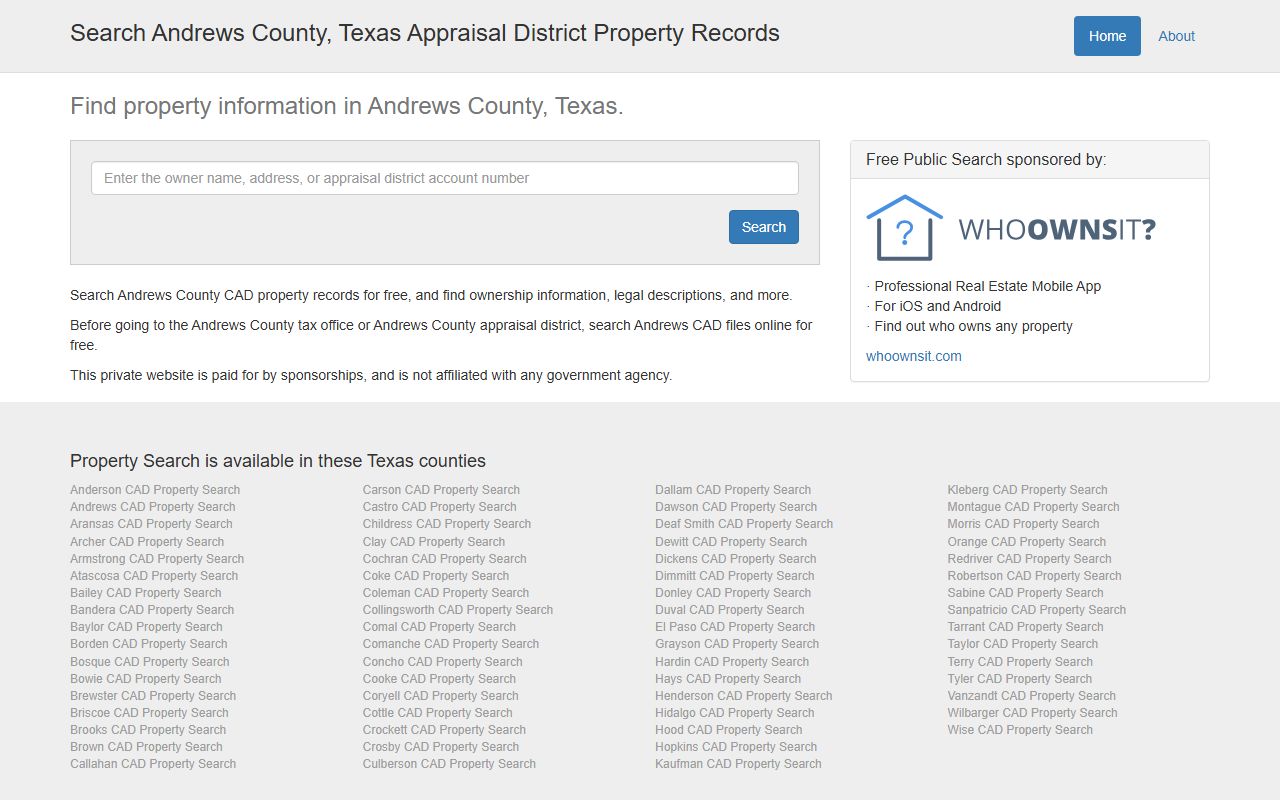
The ACAD search portal at portal.trueautomation.com/7 lets you search by owner name, property address, or property ID. Each record shows ownership information, assessed values, exemptions, and parcel characteristics. Online protest filing is available at the same portal. The deadline to protest your value is May 15 or 30 days after notice was mailed, whichever is later. Available exemptions include homestead, over-65, disability, disabled veteran, and agricultural use.
Property Tax Information
Texas collects no state property tax. In Andrews County, the appraisal district sets values, and individual taxing entities apply their own rates. Susan Brewer also serves as Tax Collector for the county, which is somewhat unusual but not uncommon for smaller Texas counties. Contact the ACAD office at (432) 523-9111 for tax payment or bill questions.
The Texas Comptroller's Property Tax Assistance Division at comptroller.texas.gov provides resources for taxpayers statewide. About 200 forms are available through the PTAD website, covering exemptions, protests, special valuations, and more. The Comptroller publishes an updated Texas Property Tax Code after each legislative session, and it is freely available online. Senate Bill 2 from the 2023 Second Special Session raised the homestead exemption from $40,000 to $100,000, which affects assessed values across all Texas counties including Andrews.
For environmental due diligence on property in Andrews County, the Texas Commission on Environmental Quality at tceq.texas.gov maintains permit records, enforcement actions, and site remediation history. Given the heavy industrial and oil field activity in the Permian Basin, checking TCEQ records before a purchase is worthwhile. The agency's Central Registry database is searchable by address and entity name.
Recording and Copying Fees
Recording fees in Andrews County follow the standard Texas schedule. The first page costs $25.00, and each additional page is $4.00. Names indexed beyond five cost $0.25 each. Certified copies cost $5.00 per document. Non-certified copies are $1.00 per page. These fees apply whether you submit documents in person, by mail, or through eRecording.
The county government records portal at tx.countygovernmentrecords.com also provides access to Andrews County records and may be useful as an alternative search option. The Texas Real Estate Commission at trec.texas.gov lets you verify the license status of any real estate agent or broker involved in a property transaction in Andrews County. The Texas State Law Library at guides.sll.texas.gov has research guides on Texas property law, title research, and real estate transactions that can be helpful for anyone doing their own title work.
Nearby Counties
Each county in Texas keeps its own property records. Be sure you are searching in the county where the land is actually located.