
Find Property Records in Young County
Young County property records are filed with the County Clerk in Graham, Texas. The clerk's office maintains deeds, deeds of trust, lien notices, oil and gas instruments, plat maps, and other documents that establish ownership and encumbrances on land in the county. You can search records online through the official county portal at no cost for basic name searches. This page explains how to access Young County property records, what types of documents are filed, and what the law says about public access in Texas.
Young County Overview
Young County Clerk Office
The Young County Clerk in Graham is the official custodian of all real property instruments filed in the county. The office records and indexes deeds, mortgages, lien notices, releases, oil and gas leases, plats, and other instruments affecting land in Young County. Once a document is filed and indexed, it becomes part of the permanent public record and is legally binding notice to anyone who deals with that property in the future.
The Young County Clerk's website at co.young.tx.us provides access to the online records portal and other county services. You can search property records there by grantor and grantee name, document type, and date. Most current records include viewable document images. If you need to file a new instrument, submit documents in person at the Graham courthouse, by mail, or through an eRecording service.
| Office | Young County Clerk |
|---|---|
| Address | 516 Fourth St., Graham, TX 76450 |
| Phone | (940) 549-8432 |
| Hours | Monday through Friday, regular business hours |
| Website | co.young.tx.us |
Young County also has an active oil and gas industry, so mineral conveyances and lease agreements make up a notable portion of what is filed with the clerk. Whether you need to verify surface or mineral ownership, the County Clerk's deed records in Graham are the primary source for all recorded instruments in the county.
Young County Property Records Search
The Young County Clerk provides online access to recorded property instruments through the county's official portal.
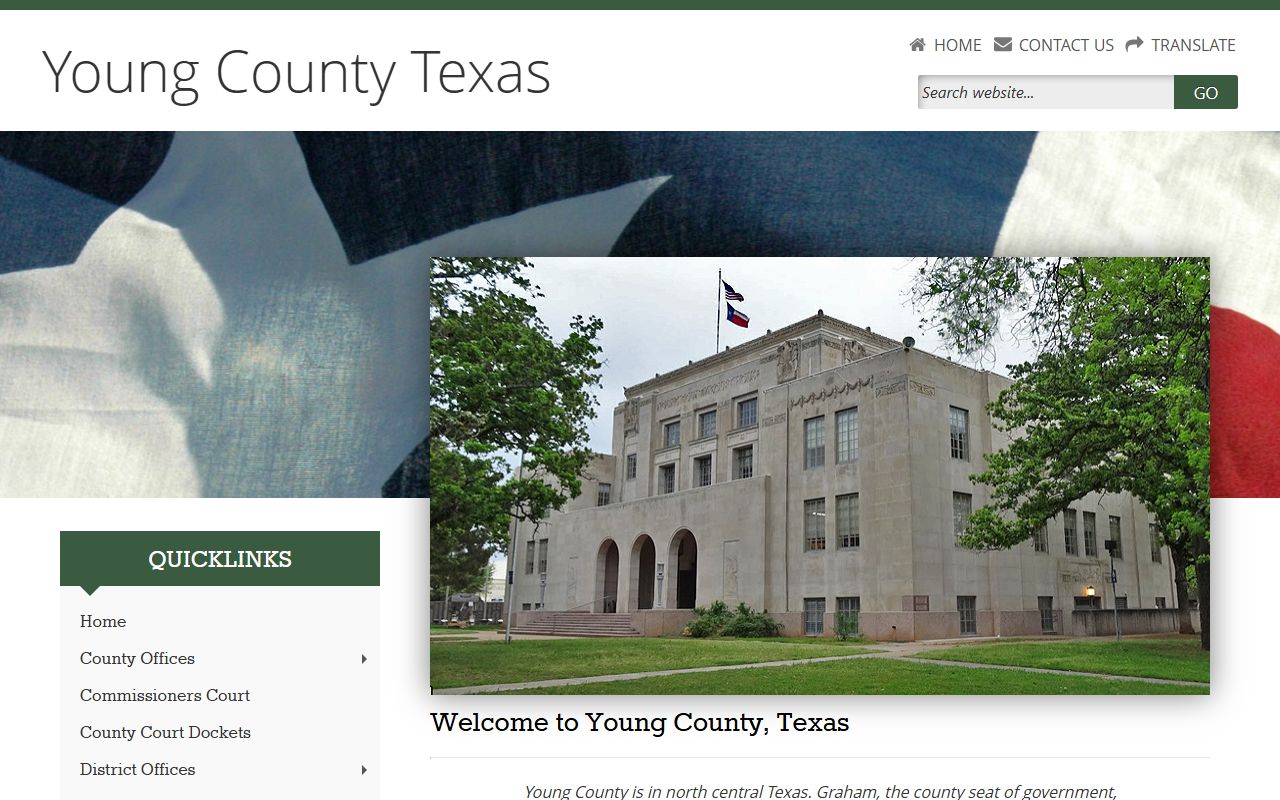
The online portal lets you search by grantor or grantee name and view document images for recorded instruments. This is the primary tool for researching deeds, liens, and other property records in Young County.
To start an online search, go to the Young County Clerk portal at co.young.tx.us. Enter the name of the grantor (person transferring property) or grantee (person receiving it), and refine by date range or document type if needed. Results show all matching recorded instruments with their filing dates and instrument numbers. Document images are typically available to view online. For older records or complex title research, an in-person visit to the Graham courthouse may be helpful. The clerk's staff can guide you to the right index or terminal but cannot conduct the search on your behalf.
Third-party services like TexasFile also carry Young County records and can be used for cross-county searches. The Young County Appraisal District website provides ownership and valuation data based on the tax rolls, which is a good cross-reference when checking who currently holds title according to the county's records.
Types of Documents in Young County Property Records
The County Clerk files a broad range of instruments that affect real property in Young County. Under Texas Property Code Section 12.001, instruments affecting interests in land must be recorded to give constructive notice to all parties. This means a buyer, lender, or anyone else who later deals with the property is legally assumed to have known about a recorded document, even if they never looked it up.
Documents commonly filed in Young County include warranty deeds, quitclaim deeds, special warranty deeds, deeds of trust, mortgage releases, mechanic's and materialman's lien notices, tax lien filings, oil and gas leases, surface use agreements, pipeline right-of-way easements, abstract of judgment filings, subdivision plat maps, and assumed name certificates. Young County's oil and gas activity means that mineral-related instruments are a frequent part of the record. If you are researching a rural tract, oil and gas lease history can be just as important as surface deed history when establishing a clear title.
Under Texas Property Code Section 13.001, a recorded instrument provides constructive notice from the time it is filed and indexed. That is why title companies search the full chain of title before closing a property sale or refinance.
Young County Appraisal District
The Young County Appraisal District maintains property ownership and valuation data for all taxable parcels in the county. The CAD is a separate agency from the County Clerk, but its ownership records are derived from deeds recorded at the clerk's office. You can search the appraisal district database by owner name, address, or account number to find current ownership and appraised value. The appraisal district site also shows what taxing entities apply to any given parcel, which matters when estimating property tax liability.
Property owners who believe their appraised value is incorrect can file a protest with the Appraisal Review Board within the deadline shown on their annual appraisal notice. The ARB holds informal and formal hearings to review protests. The Young County Appraisal District office in Graham can explain the process and provide the forms needed to file. Appraisal district records update each year when new deeds and valuation data are processed.
Recording Fees and Procedures
Recording a document with the Young County Clerk costs $26 for the first page. Each additional page costs $4.00. Those fees are established by the Texas Local Government Code and are standard across most Texas counties. Documents with more than five indexed names carry an extra $0.25 per name above five.
Documents can be submitted in person at the courthouse on Fourth Street in Graham, by mail with payment made out to the County Clerk, or through an approved electronic recording service. eRecording vendors such as Simplifile and CSC work with many Texas county clerks including Young County and allow documents to be submitted and returned without physical mailing. Once the document is recorded, it receives an instrument number, a recording date, and is returned to the submitting party. Records are indexed and go live in the online system within a few days of recording in most cases.
Certified copies of recorded documents cost $1.00 per page plus a $5.00 certification fee. Uncertified copies cost less. For most research needs, uncertified copies are fine. Ask for a certified copy only when required for legal or government purposes.
Texas Public Information Act
All property records filed with the Young County Clerk are public under Texas Government Code Chapter 552. Anyone can request and receive copies of recorded instruments without stating a reason. You do not need to own property in Young County or be a party to the document. The clerk must acknowledge requests promptly and provide records in a timely manner. Since most property records are already indexed and searchable online, access is generally immediate for current documents.
Some personal data is shielded from online access. Social security numbers and financial account numbers must be redacted from online document images under Texas Property Code Section 11.008(k). If you see blank or blacked-out fields in an online record, that is the reason. The unredacted original is in the paper file at the clerk's office. Disputes over public records access can be directed to the Texas Attorney General's Open Government Division.
Additional Research Resources
The Texas Comptroller's Property Tax Assistance Division provides statewide resources for property owners and researchers. That site covers exemptions, protest procedures, appraisal district data, and the overall structure of the Texas property tax system. Young County is served by local taxing entities that set their own rates each year, and the Comptroller's site helps you understand how those rates are determined and applied.
For historical land research, the Texas General Land Office holds original land grant records predating Texas statehood. Young County land was conveyed through the Texas land grant system, and tracing a property's chain of title back to its original patent requires the GLO archive. The archive is searchable by grantee name and abstract number. The Texas Secretary of State's SOSDirect handles UCC liens and business entity records that can affect property transactions involving companies. The Texas State Law Library publishes free guides on property law in Texas that are useful for anyone navigating deed research or title issues in Young County.
Nearby Counties
Young County borders several counties in North-Central Texas. Property near a county line may be recorded in a different county's system. Confirm which county a parcel is in before searching.