
Property Records in Baylor County
Baylor County property records are held by the County Clerk in Seymour, Texas. The clerk records and maintains deeds, liens, mortgages, easements, and other instruments affecting real property in the county. You can search Baylor County land records online or contact the office directly for copies. This guide explains the search process, what types of documents are on file, how the appraisal district complements the deed records, and what fees apply when recording a new instrument.
Baylor County Overview
Baylor County Clerk Office
The Baylor County Clerk in Seymour maintains all real property records for the county. The office records warranty deeds, deeds of trust, lien notices and releases, oil and gas leases, easements, and subdivision plats. Every instrument filed with the clerk gets an instrument number and is indexed by party name, making name searches the primary way to locate documents. The clerk's office is in the Baylor County Courthouse in Seymour.
Baylor County is a rural North Texas county with an agricultural and oil and gas economy. Land records in the county reflect this character, with oil and gas leases, surface use agreements, and farm and ranch deeds appearing frequently in the index alongside standard residential deed documents. The clerk's office processes recordings from all of these property types.
| Office | Baylor County Clerk |
|---|---|
| Address | 101 S. Washington St., Seymour, TX 76380 |
| Phone | (940) 889-3322 |
| Hours | Monday through Friday, regular business hours |
| Website | co.baylor.tx.us |

The county's website at co.baylor.tx.us provides contact information and links to county departments. For certified copies or questions about specific instruments, call or visit the clerk's office directly.
Searching Baylor County Land Records
Baylor County property records can be searched online at no cost. The records system lets you search by grantor name, grantee name, or document type and date range. Results show the recording date, document type, and party names, along with a link to view the document image. If you have an instrument number from a prior search, you can use it to pull up the exact document.
In-person searches are available at the clerk's office during business hours. You can use the public terminals to search the index yourself. Staff can direct you to the right index or system but cannot search on your behalf under Texas AG guidance. For a comprehensive chain of title search, consider hiring a local abstract company or title firm. These businesses know the Baylor County indexes well and can produce a full title report.
Mail requests for copies are also accepted. Include the party name, approximate date range, and instrument number if known. Enclose payment for copy fees. The office will mail the copies when ready.
Types of Baylor County Property Records
The Baylor County Clerk records all instruments that affect real property in the county. Under Texas Property Code Section 12.001, recording an instrument gives constructive notice to everyone who later deals with that property. Texas Property Code Section 13.001 makes recorded documents binding on future buyers and lenders.
Common document types in Baylor County include warranty deeds and special warranty deeds for property transfers; deeds of trust and mortgage releases for loans; mechanic's and materialman's liens; tax lien filings; oil and gas leases, assignments, and pooling agreements; surface use agreements; easements and pipeline right-of-way documents; agricultural leases; and subdivision plats. Given the county's oil and gas activity, mineral deed severances and royalty assignments appear in the records with some regularity. Searching by party name will surface all documents tied to a specific person or entity, including mineral conveyances and leases.
Note: Mineral rights and surface rights can be separately owned in Texas. A deed search in Baylor County may turn up both surface deeds and mineral deeds under the same names.
Baylor County Appraisal District
The Baylor County Appraisal District maintains official appraisal records for all taxable property in the county. The CAD assigns annual appraised values for tax purposes, tracks ownership based on filed deeds, and handles exemption applications. Its database is searchable online and is useful for verifying current ownership and assessed value before doing a full deed search.
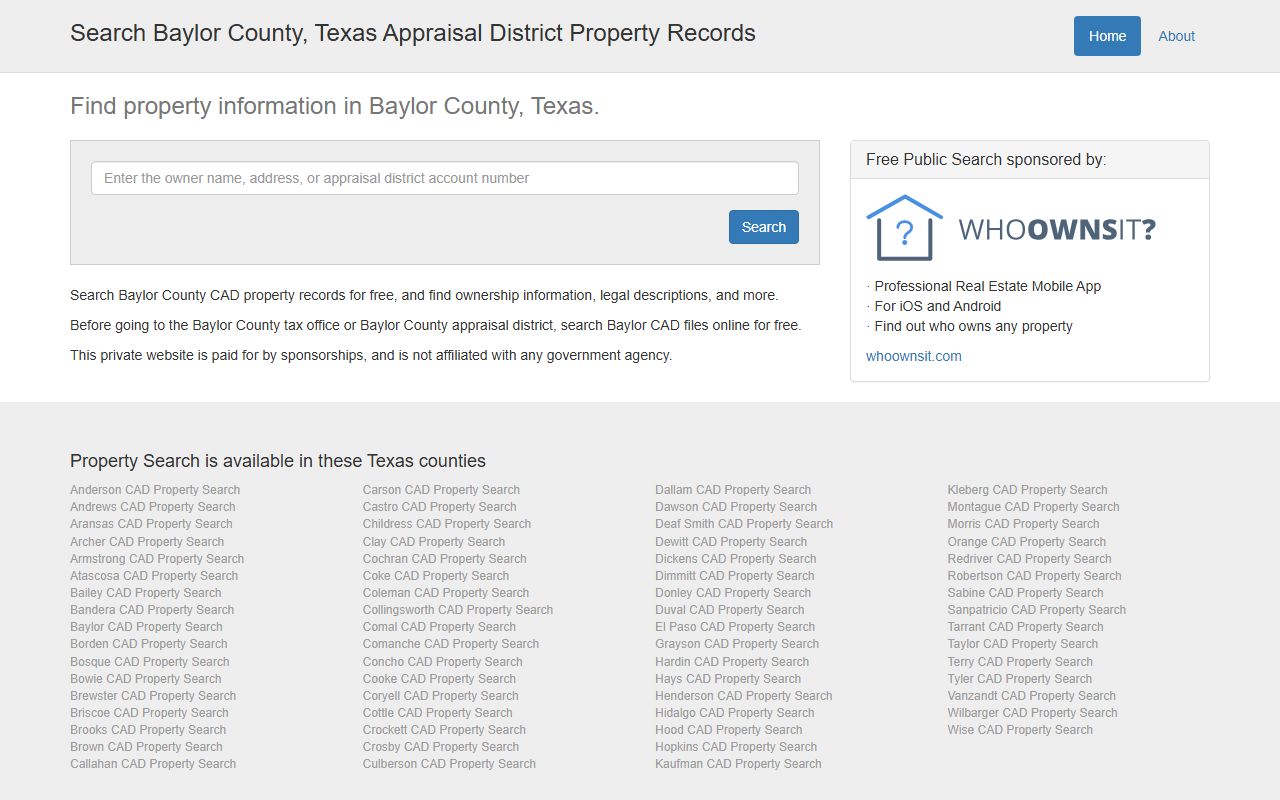
Search the CAD at baylorcad.com by owner name, property address, or account number. Results include the current appraised value, property characteristics, exemptions, and the taxing entities that apply to the parcel. Baylor County property is subject to county taxes, school district taxes, and any applicable special district levies.
If you think your appraised value is too high, you can file a protest with the Appraisal Review Board. The deadline is May 15 or 30 days from the date of your notice, whichever is later. The CAD website has protest forms and instructions. Agricultural use exemptions are also available for qualifying farmland and ranchland, and the CAD handles those applications as well.
Recording Fees and Procedures
Baylor County follows the standard Texas recording fee schedule. The fee is $26 for the first page and $4.00 for each page after that. An additional $0.25 applies for each party name over five that must be indexed. These fees apply to all instrument types and are set by state law.
Documents can be submitted in person, by mail, or through eRecording. Personal delivery at the courthouse in Seymour is straightforward. Mail submissions should include a check or money order payable to the Baylor County Clerk. eRecording services like Simplifile are available for title companies and lenders who prefer electronic submission. eRecording is faster than mail or in-person delivery and provides electronic confirmation of recording.
Documents must meet Texas formatting standards before submission. The first page needs a 3-inch blank margin at the top right for the recording stamp. All other margins must be at least 1 inch. Required elements include the names of all parties, a legal description of the property, and proper notarization where required. Documents that do not meet these standards will be returned without recording.
Once recorded, documents get a unique instrument number and recording date. The original is returned to the submitting party, and the indexed record becomes available in the public search system within a few business days.
Texas Public Information Act
Baylor County property records are public under Texas Government Code Chapter 552. The Public Information Act gives any person the right to request and receive copies of government records. No reason is required. You do not need to own the property or be a party to any transaction to access deed records or other instruments in the clerk's files.
The clerk must respond to records requests promptly. If production will take more than ten business days, the office must notify you. For most property records that are already indexed, the turnaround is fast. If a records request is denied, the Texas Attorney General's Open Government Division can review the denial and issue an opinion on whether the records are properly withheld.
Some personal data in recorded documents is redacted from online images. Social security numbers and financial account numbers are removed from documents viewable through the public portal. The full information remains in the original paper record held by the clerk.
Additional Property Research Resources
The Texas Comptroller's Property Tax Assistance Division provides statewide resources including exemption forms, protest guidance, and local tax rate data. Baylor County property owners can use these to understand how the local tax system works and what exemptions may apply.
The Texas General Land Office maintains original land grant records including early Texas state patents for Baylor County lands. For any property with roots going back to the 19th century, the GLO archive is the starting point for tracing ownership before county records begin.
The Texas Secretary of State's SOSDirect is useful when a recorded instrument involves a corporation, LLC, or other business entity. You can verify the legal name, registered agent, and status of any Texas entity through SOSDirect. UCC financing statements at the state level that may affect business property are also searchable here.
The Texas State Law Library has free research guides covering Texas property law topics including recording requirements, mineral rights, easements, and title research methods relevant to Baylor County property owners.
Nearby Counties
Baylor County is in North Texas and shares borders with several surrounding counties. If a property is near a county line, confirm its location before searching.