
Search Property Records in Tarrant County
Tarrant County property records are filed with the County Clerk in Fort Worth and go back to 1876. The county serves more than 2 million residents and is home to Fort Worth, Arlington, Mansfield, and dozens of other cities. You can search deeds, liens, mortgages, oil and gas documents, and other land records online through the county's EagleWeb portal at no charge for basic name lookups. Whether you need to verify ownership, check for liens, or pull a recorded deed, this page explains how the system works and where to find what you need.
Tarrant County Overview
Tarrant County Clerk Office
The Tarrant County Clerk maintains all official property records for the county. The main office sits at 200 Taylor Street in Fort Worth, and branch locations are available at several points around the county. Staff indexes every recorded instrument and makes documents available through the online search portal. The clerk handles deed records, liens, UCC filings, federal tax liens, assumed name certificates, and much more.
Records in this office go back to 1876. The clerk records and indexes over 80 document types covering real property, business filings, vital records, and court documents. For property research specifically, the deed records, mortgage records, and lien files are the most commonly accessed. The office accepts documents by mail, in person, and through eRecording vendors that operate 24 hours a day.
| Office | Tarrant County Clerk |
|---|---|
| Address | 200 Taylor Street, Fort Worth, TX 76102 |
| Phone | Available through county website |
| Hours | Monday through Friday, regular business hours |
| Website | access.tarrantcounty.com |
The county also offers a property fraud alert service. Owners can sign up to receive a notification any time a document is recorded against their property. This is a free service and takes just a few minutes to set up through the clerk's website. Given the volume of transactions in Tarrant County, this is worth using if you own land here.
Search Tarrant County Property Records Online
Tarrant County uses the EagleWeb system for online property record searches. You can reach it through the County Clerk's page. The system lets you search by grantor name, grantee name, document type, date range, book and page number, or instrument number. Results show the recording date, document type, the names of all parties, and a link to the document image. Most documents recorded in recent years have full images available to view online.

The search interface has an advanced panel with filters for document type and date range. You can look up all documents recorded by a party in a given year, or narrow results by document category. The system saves recent searches during your session, which helps when you need to compare multiple properties. For the most current data, the EagleWeb system is updated on a rolling basis as documents are processed by the clerk's office.
For in-person searches, go to the main clerk's office at 200 Taylor Street. Public terminals are available in the office. Staff can help you get oriented with the system, but under Texas AG Opinion WW-607, clerks cannot conduct searches on your behalf. You search the index yourself. If you need a professional to run a full title search, a title company or licensed abstracter can do that work for you.
Note: Third-party search tools like TexasFile also index Tarrant County records and can serve as a backup option if the county portal is temporarily unavailable.
Types of Tarrant County Property Records
The County Clerk records more than 80 document types in Tarrant County. Property-related filings make up the bulk of daily volume. Under Texas Property Code Section 12.001, an instrument must be recorded to give legal notice to the public of its contents. Once filed, a document becomes part of the permanent public record and is indexed under all party names.
Common property documents filed in Tarrant County include general warranty deeds, special warranty deeds, quitclaim deeds, deeds of trust, releases and satisfactions, mechanic's and materialman's liens, tax lien filings, oil and gas leases, mineral deeds, assignments, easements and right-of-way documents, subdivision plats and replats, power of attorney documents, and assumed name certificates. Each document gets a unique instrument number and a recording date stamp.
Plat maps are stored as large-format originals and are indexed separately from deeds. If you are buying land in a platted subdivision in Fort Worth, Arlington, Mansfield, or anywhere else in Tarrant County, checking the recorded plat will show you the lot boundaries, setback lines, and any easements that were created when the subdivision was approved.
Under Texas Property Code Section 13.001, recording gives constructive notice to all subsequent buyers and lenders. This is the legal reason why title companies run full searches before closing. Any lien or deed recorded before your purchase date is binding on you as the new owner, even if you did not know about it.
Tarrant Appraisal District
The Tarrant Appraisal District (TAD) is the agency responsible for setting appraised values on all taxable property in the county. TAD records are separate from the County Clerk's deed index but are just as important for property research. The TAD database shows current ownership, appraised value, exemption status, sales history, and detailed property characteristics for every parcel in Tarrant County.
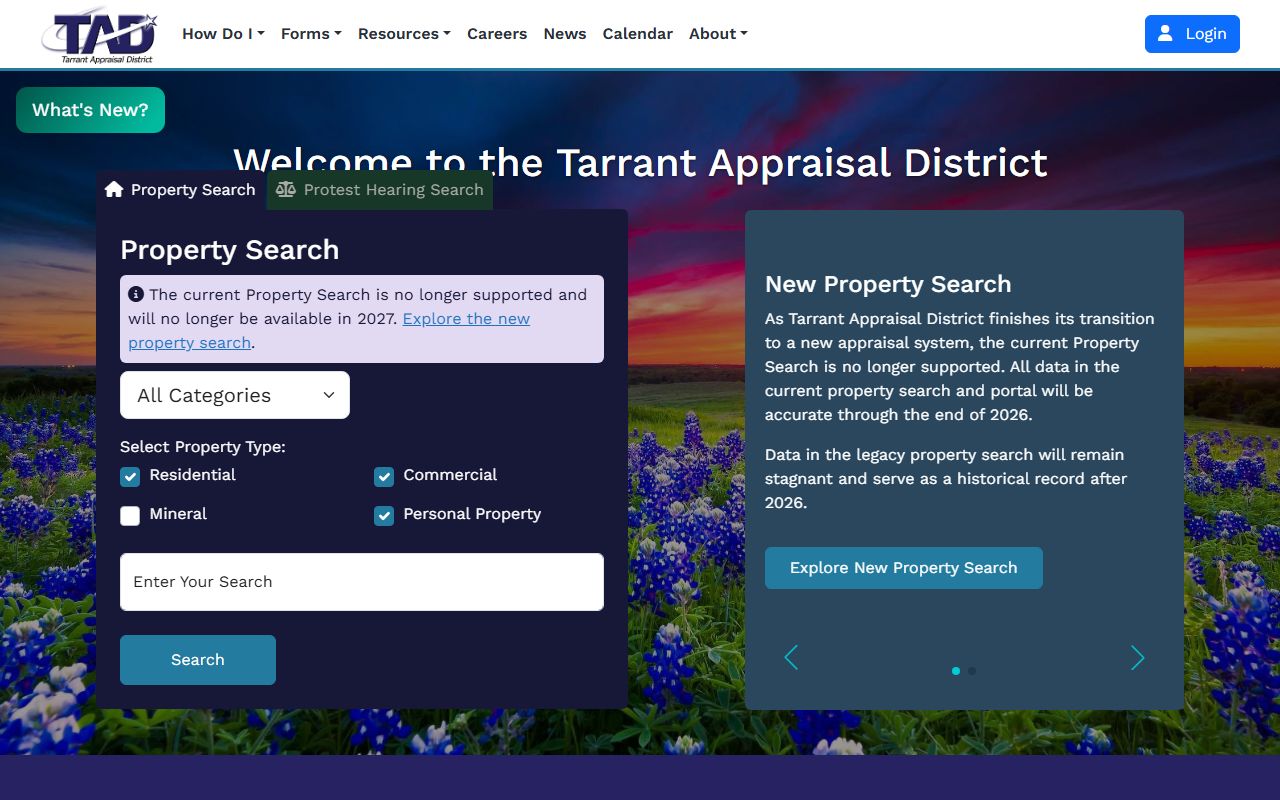
Chief Appraiser Jeff Law heads the agency. TAD's online search at tad.org lets you look up properties by owner name, address, account number, or legal description. The search includes phonetic name matching, which helps when you are not sure of the exact spelling. The GIS feature shows property boundaries overlaid on aerial imagery, with school district boundaries, city limits, and flood zone data also available on the map.
Value history goes back ten years in the TAD system. You can see what a property was appraised at in prior years alongside the current figure. If you want to protest your value, TAD accepts online protests and the deadline is May 15 or 30 days after your notice mails, whichever is later. Exemptions including homestead, over-65, and disability can also be applied for through the TAD website.
Note: TAD data and County Clerk deed data are separate systems. A property may show a prior owner in TAD if a recent deed has not yet been processed by the appraisal district. Always check both systems when doing thorough due diligence.
Recording Fees and Procedures
Recording a document with the Tarrant County Clerk costs $26 for the first page. Each additional page is $4.00. If more than five names need to be indexed, there is a $0.25 charge for each name over five. These fees are set by state law and are standard across most Texas counties.
Documents can be submitted in person at the main Fort Worth office, by mail, or through eRecording. The county accepts eRecording submissions 24 hours a day, seven days a week, and same-day processing is often available for electronically filed documents. Major vendors like Simplifile and CSC connect directly to the clerk's system. eRecording is the fastest way to get a document into the record.
Copy fees at the office are $0.25 per page for office-printed copies. Email delivery of document images costs $1.00 per page. Certified copies run $5.00 plus $1.00 per page for paper certification, or $5.00 plus $0.25 per page for electronic certified copies. If you only need a copy for research purposes, a plain uncertified copy is cheaper and works fine for title work and lien checks.
Texas Public Information Act
Property records in Tarrant County are public documents under Texas Government Code Chapter 552, the Public Information Act. Anyone can request copies without giving a reason. You do not need to own the property or be a party to the document to access it. The clerk's office must respond promptly and, if production will take more than ten business days, must notify you in writing of the timeline.
Most Tarrant County property records are accessible immediately because they are already indexed and online. For older or archived documents not in the online system, a formal PIA request may be needed. The Texas Attorney General's Open Government Division handles disputes about public records access and publishes guidance on what agencies must release. If the clerk's office denies a request, you can seek an AG opinion.
Some personal data within recorded documents is redacted from online images. Social security numbers and financial account numbers are removed under Texas Property Code Section 11.008(k). The original paper record held by the clerk contains the full information, but online images show those fields as blank.
Additional Property Research Resources
The Tarrant County Tax Assessor-Collector handles property tax collection for the county and its taxing entities. You can look up tax bills, pay online, and check for delinquent taxes. Tax certificates are available online. Payment plans exist for delinquent accounts. Over-65 and disabled deferrals can be applied for through this office as well.
The Texas Comptroller's Property Tax Assistance Division provides statewide resources on exemptions, protest procedures, and property tax law. The Texas General Land Office has historical land grant records for properties with roots going back to the Republic of Texas or earlier. The Texas Secretary of State's SOSDirect is useful for UCC lien searches and business entity records that may affect property titles.
Fort Worth and Arlington each have their own city portals for permits, zoning, and building records. For property in Fort Worth, the city's development services department maintains permit and inspection records. Arlington and Mansfield also have their own local portals. These city records complement the county deed and appraisal records when you need a full picture of what has happened at a property.
The Texas State Law Library publishes research guides on property law, recording requirements, and title issues. These guides are free and useful if you run into a legal question about how a particular document affects ownership or liens in Tarrant County.
Nearby Counties
Check the right county before you search. Tarrant County borders several North Texas counties. Properties near a county line may be recorded in a neighboring county's system.