
Orange County Property Records
Orange County property records are held by the County Clerk in Orange, Texas, with deeds, liens, mortgages, oil and gas leases, and other land documents on file going back to 1852. Whether you need to check who owns a parcel, trace a chain of title, or get a certified copy of a recorded deed, this page covers the main offices and online tools that serve Orange County.
Orange County Overview
Orange County Clerk Records
The Orange County Clerk is the official keeper of real property records for the county. Brandy Robertson serves as County Clerk. The office is at 123 S 6th St, Orange, TX 77630, and the phone number is (409) 882-7055. Hours are Monday, Tuesday, Thursday, and Friday from 8:00 AM to 5:00 PM. Note that the office is closed on Wednesdays.
Records on file include deeds, mortgages, deeds of trust, oil and gas leases, mineral deeds, liens, UCC filings, assumed name certificates, marriage licenses, civil cases, probate cases, and misdemeanor criminal cases. The archive goes back to 1852, when Orange County was formed from Jefferson County. That means you can find documents from the early settlement era of Southeast Texas. No major courthouse fires have been reported, so the historical record is largely complete from that point forward.
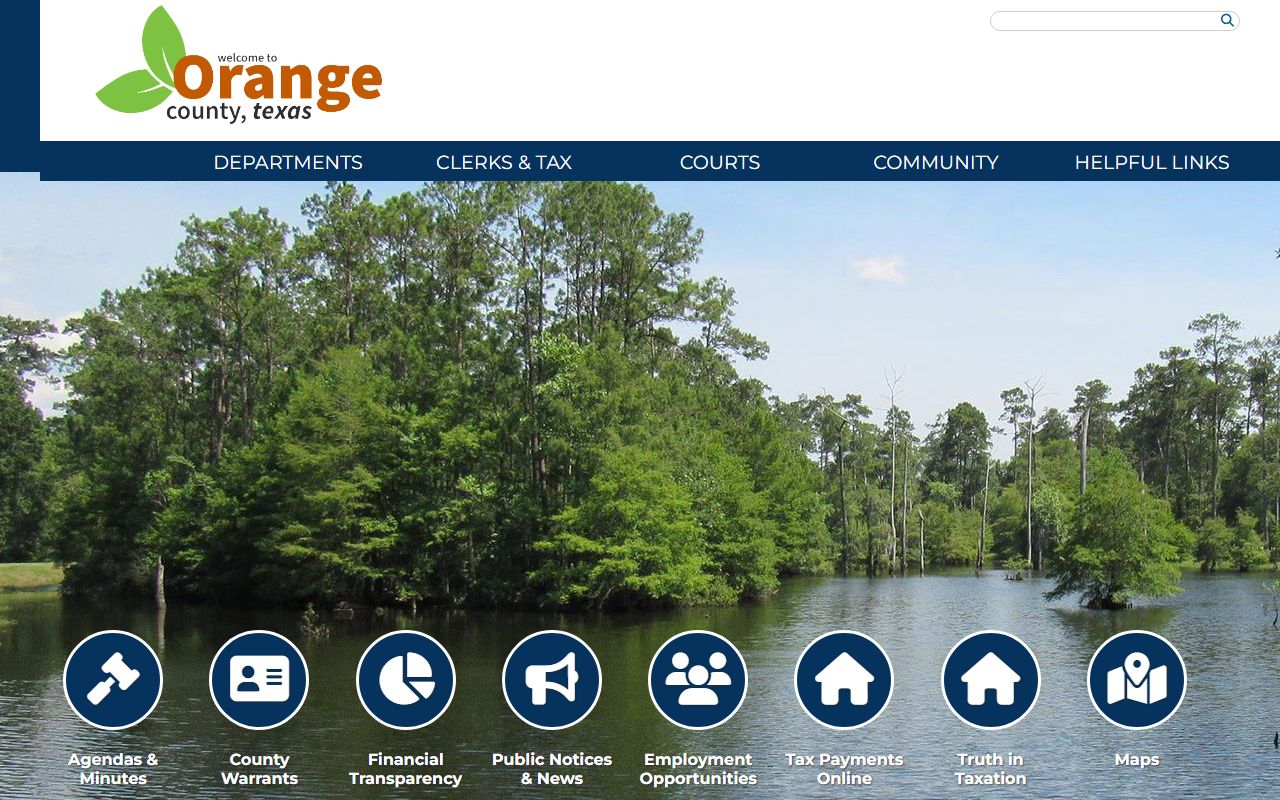
The county's online search portal is at co.orange.tx.us. You can search by name, document type, date range, instrument number, and case number. PDF downloads are available for most records. Free image access is provided through the portal for basic searches.
The official county clerk page outlines all services and contact details. If you need staff to search records on your behalf, there is a $5.00 fee per name. That type of search must be submitted in writing with payment included. Staff will not conduct searches over the phone or by email. Most people use the online portal to do their own research at no cost.
For mail requests, send to 123 S 6th St, Orange, TX 77630 with a check made out to the Orange County Clerk and a self-addressed return envelope. Copies cost $1.00 per page and certified copies require a $5.00 certification fee per document.
Note: Under Texas Attorney General Opinion WW-607, county clerks are not required to perform general property searches. You must search records yourself or hire a title professional to do it for you.
Search Orange County Property Records Online
Several online tools cover Orange County. The official clerk portal is the best starting point for current and historical records. TexasFile at texasfile.com also indexes Orange County documents and lets you search by name, document type, or date. Basic index searching is free. Getting document images costs a per-page fee or a subscription. CourthouseDirect at courthousedirect.com is another option that covers this county.
Document types available include warranty deeds, quitclaim deeds, special warranty deeds, deeds of trust, mechanic's liens, tax liens, judgment liens, releases and satisfactions, oil and gas leases, mineral deeds, UCC filings, and plat maps. Orange County sits on the Gulf Coast near the Louisiana border and has a significant history of oil and gas activity, so mineral records are well represented in the archive. Many records also reflect industrial and petrochemical development tied to the Beaumont-Port Arthur area.
Texas Property Code Section 12.001 sets recording requirements that apply to all instruments filed with county clerks across Texas. Recording your deed or mortgage promptly after closing protects your rights against third parties who might otherwise have no notice of your transaction.
Orange County Appraisal District
The Orange County Appraisal District (OCAD) sets property values for tax purposes in the county. Scott W. Overton serves as Chief Appraiser. The mailing address is P.O. Box 457, Orange, TX 77631, and the phone is (409) 745-4777.
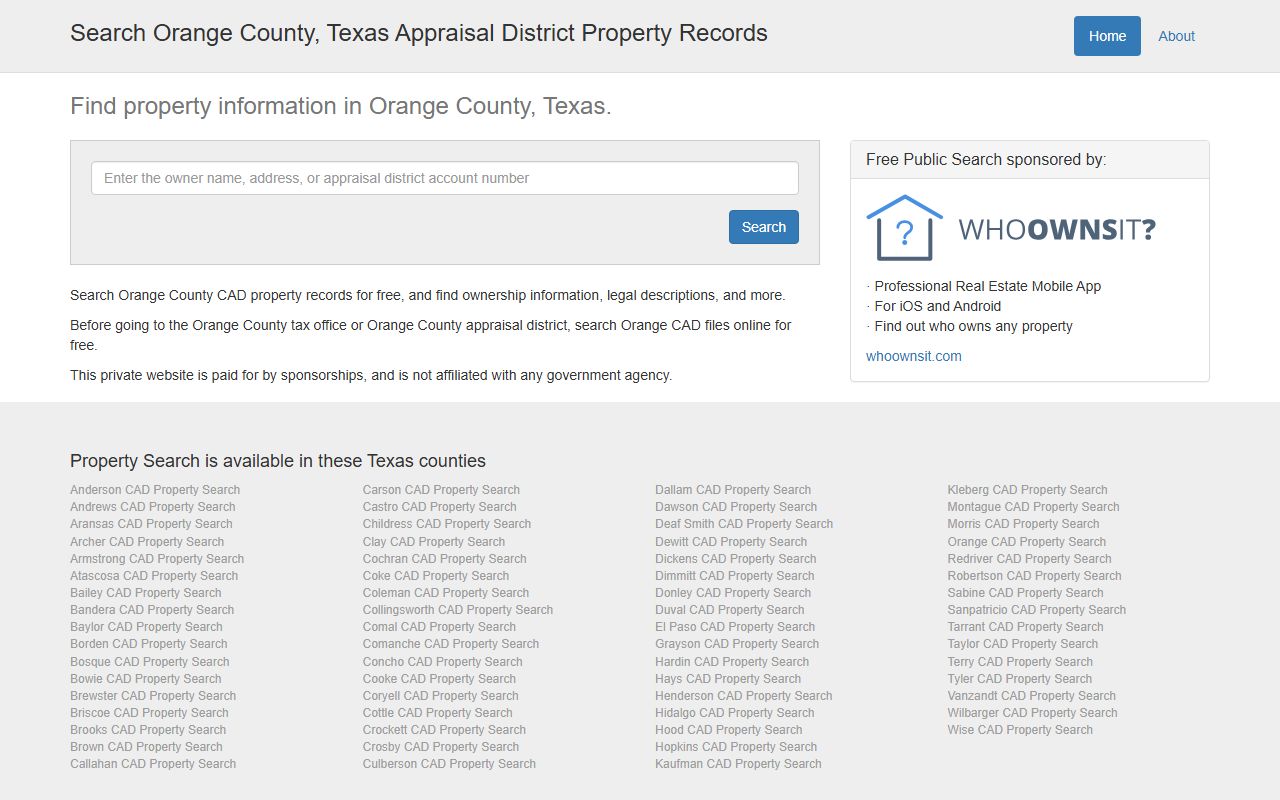
The OCAD maintains records on every parcel in the county. Each property card shows the legal owner's name, the property address, the legal description, land and improvement values, total appraised value, market value, and any exemptions that have been applied. Common exemptions include homestead, over-65, disability, and disabled veteran. Agricultural use (1-d-1) valuations are also available for qualifying farm and ranch land.
Searches by owner name, property address, or account number are generally available through the appraisal district. If your noticed value seems wrong, you can file a protest with the Appraisal Review Board. The deadline is May 15 each year or 30 days after the notice mails, whichever comes later.
Property Tax Records in Orange County
Texas has no state property tax. All property taxes are set and collected locally. In Orange County, taxing entities include the county, school districts, the City of Orange, and various special districts. The appraisal district sets the value; each taxing unit sets its own rate and sends out its own bill.
The Texas Comptroller's Property Tax Assistance Division at comptroller.texas.gov provides statewide oversight. The Comptroller conducts biennial Property Value Studies and publishes the Texas Property Tax Code after each legislative session. If you disagree with your appraised value, your first step is filing a protest with the Orange County Appraisal Review Board. If you are still unsatisfied after the ARB hearing, you can request binding arbitration or file a lawsuit in district court under the Texas Property Tax Code.
Senate Bill 2 from the 2023 Second Special Session increased the homestead exemption from $40,000 to $100,000 statewide. If you own and occupy your home in Orange County as your primary residence and have not yet applied for this exemption, contact the OCAD to file. The exemption lowers your taxable value and can reduce your annual tax bill significantly.
Note: For help understanding property tax protests and appeals, the Texas State Law Library at guides.sll.texas.gov has free research guides on this topic.
Oil, Gas, and Mineral Records
Orange County's location in the Gulf Coast region and its proximity to the Beaumont-Port Arthur oil corridor means the County Clerk's archive has a large volume of mineral records. You will find oil and gas leases, mineral deeds, royalty assignments, division orders, and related instruments recorded going back to the early 1900s. These records are important if you are trying to determine whether mineral rights are severed from surface ownership or checking the status of a lease.
In Texas, mineral rights can be severed from surface ownership and conveyed separately. When that happens, the deed conveying the surface will note the reservation of minerals, or a separate mineral deed will appear in the chain of title. The Texas Rule of Capture applies to oil and gas in Texas, meaning the mineral owner whose wells capture oil and gas owns it regardless of where it migrated from underground. Lease records in the Orange County archive document the terms under which operators have the right to drill and produce.
The Texas Secretary of State's SOSDirect system at direct.sos.state.tx.us covers UCC filings that can reflect liens on mineral interests, pipeline easements held by companies, and other business-related property encumbrances. For easement and right-of-way matters, the Texas Real Estate Commission at trec.texas.gov licenses easement agents and provides consumer protection information. If you have questions about environmental conditions affecting a property, the Texas Commission on Environmental Quality at tceq.texas.gov maintains a searchable database of permits, spill records, and compliance actions.
Public Information Act and Record Access
All real property records recorded with the Orange County Clerk are public records under Texas law. The Texas Public Information Act, found at Government Code Chapter 552, gives every person the right to inspect or copy government records. You do not have to explain why you want them or who you are. The Texas Attorney General's Open Government division at texasattorneygeneral.gov can assist if a governmental body fails to respond within ten business days.
Some information in property records is subject to redaction. Texas Property Code Section 11.008 requires certain personal information, like social security numbers and financial account numbers, to be redacted from online access. The County Clerk handles this redaction before documents appear in public search portals. If you believe a document contains information that should have been redacted, you can contact the clerk's office directly.
The Texas Department of State Health Services vital records section at dshs.texas.gov handles birth and death records that can affect property title, particularly in heirship and probate situations. The Texas Comptroller Eminent Domain Database at comptroller.texas.gov lists entities authorized to exercise eminent domain, which is relevant if you are researching pipeline or utility easements affecting property in Orange County.
Nearby Counties
Property records are maintained county by county. If land crosses county lines or you are unsure which county a parcel falls in, search each county separately.