
Marion County Property Records
Marion County property records are filed with the County Clerk in Jefferson, Texas. The clerk keeps all recorded land documents for the county, including deeds, deeds of trust, liens, and easements. If you need to look up ownership, check a lien, or trace the history of a piece of land in Marion County, this page will walk you through how the system works, where to search, and what to do when you find what you need.
Marion County Overview
Marion County Clerk Office
The Marion County Clerk is the official keeper of real property records in the county. The office is in Jefferson, the county seat, and handles all recording, indexing, and storage of land documents. Every deed, lien, mortgage, and easement filed in Marion County goes through this office.

The clerk indexes all recorded documents by the names of the parties. You can search by the grantor (the party conveying the property) or the grantee (the party receiving it). The office also maintains physical index books for older records that predate the digital system. If you need records going back many decades, some documents may only exist in the original paper indexes.
| Office | Marion County Clerk |
|---|---|
| Location | Marion County Courthouse, Jefferson, TX 75657 |
| Website | co.marion.tx.us |
| Hours | Monday through Friday, regular business hours |
| Recording Fee | $26 first page, $4 each additional page |
For online searches, you can use the county's official portal or access records through TexasFile. Free basic name lookups are available. Certified copies require a visit or written request to the clerk's office in Jefferson.
Search Marion County Property Records
Start your search by using the grantor or grantee name. The clerk indexes every recorded instrument under both the name of the party giving the property and the name of the party receiving it. This dual indexing makes it possible to trace title from either direction. If you know the recording date range, use it to narrow results.
For properties that have changed hands several times, you may need to follow a chain of title across multiple documents. Start with the most recent deed and work backward. Each deed will reference the prior instrument or recording information, which lets you trace the chain.
Third-party sites like TexasFile and similar aggregators pull data from the county's official records and make searching faster. They are a good starting point. But for critical transactions like a property purchase, always confirm findings directly with the Marion County Clerk. The clerk's index is the authoritative source.
Note: The clerk's staff can assist you in locating indexes but cannot conduct searches on your behalf under Texas AG guidance.
Types of Property Records in Marion County
The Marion County Clerk records all instruments affecting real estate in the county. Under Texas Property Code Section 12.001, instruments must be recorded to provide legal notice to the public. Common types of documents recorded with the clerk include warranty deeds, special warranty deeds, quitclaim deeds, deeds of trust, and trustee's deeds.
Lien instruments are also a major category. These include mechanic's and materialman's liens, which contractors file when they haven't been paid for work on a property. Tax lien notices, federal tax liens, and lien releases are all recorded here too. Oil and gas leases are commonly filed in East Texas counties and can cover both surface and mineral rights. Easements and right-of-way agreements recorded with the clerk affect how land can be used and accessed.
Plat maps are filed when a property is subdivided. They establish lot boundaries, street layouts, and easement locations. Once a plat is recorded, lots within that subdivision are identified by block and lot number rather than a metes-and-bounds description. The Marion County Clerk holds all plats on file and can provide copies for a fee.
Marion County Appraisal District
The Marion County Appraisal District maintains appraisal records for all taxable property in the county. The CAD database is a separate system from the County Clerk's records. It shows ownership as listed on the tax rolls, appraised values, exemptions, and property details like acreage and improvements. These records are public and can be searched by owner name, address, or account number.
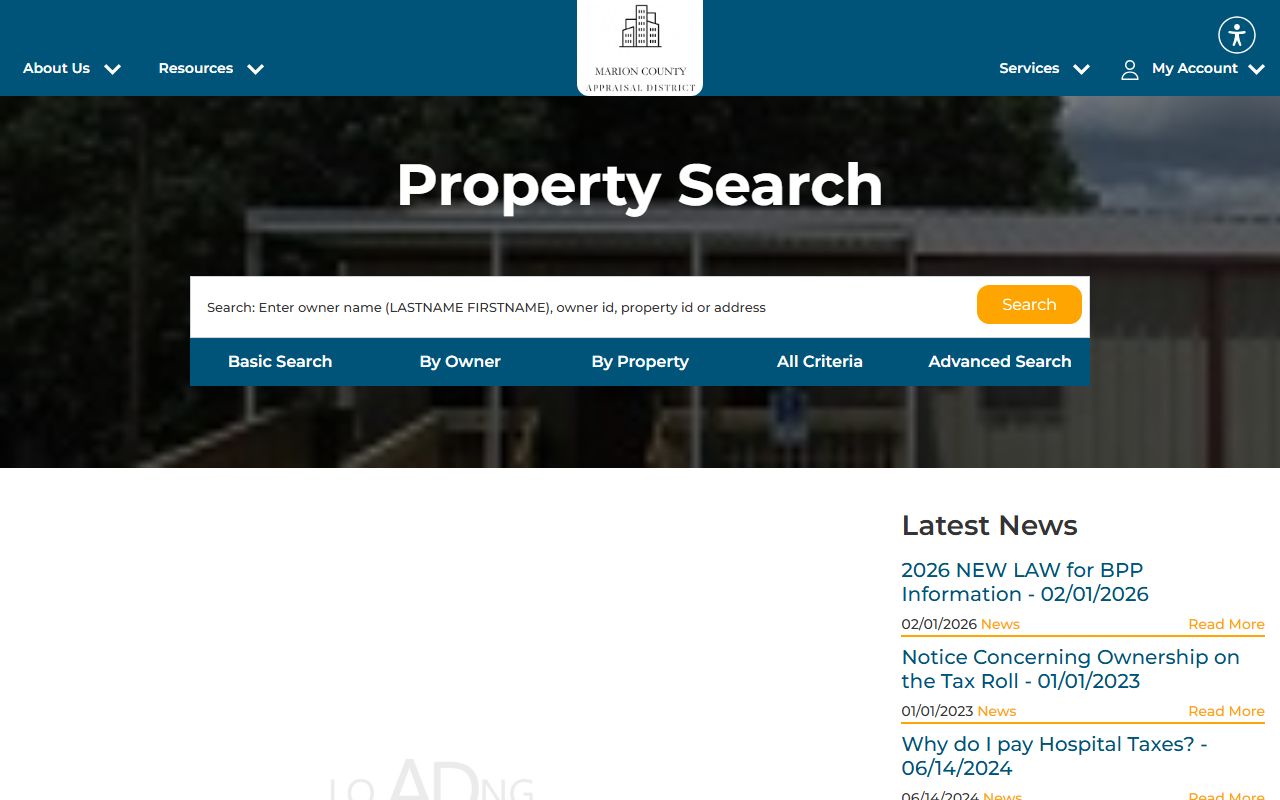
If you think your property value is too high, you can file a protest before the May 15 deadline. The appraisal review board hears protests and can lower values when evidence supports it. The district also accepts applications for homestead, over-65, and disability exemptions through their website at marioncad.com.
Keep in mind the appraisal district updates ownership records from deed filings, but there can be a delay of several months after a transfer before the new owner shows up in the CAD system.
Recording Fees and Submission Methods
The Marion County Clerk charges $26 to record the first page of any document and $4 for each additional page. This fee schedule is set by the Texas Legislature under Local Government Code Section 118.011. If a document names more than five parties to be indexed, each name over five adds $0.25 to the fee.
You can file documents in person at the courthouse, by mail with a check payable to the County Clerk, or through an eRecording service. eRecording is the fastest and most reliable method for title companies, lenders, and attorneys. The document is submitted and returned electronically with the recording stamp. Services like Simplifile and CSC are commonly used with Texas county clerks.
Once a document is recorded, the original is returned to the submitting party. The document is then indexed and made available through the county's search system. Copies of recorded documents cost $1.00 per page. Add $5.00 for a certified copy if one is needed for legal or government purposes.
Public Access Under Texas Law
Marion County property records are public documents. Under Texas Government Code Chapter 552, the Public Information Act, anyone can request access to government records. You don't need to be the property owner or have a specific legal interest to look up recorded documents.
The clerk must respond to records requests promptly. For records that are already indexed and accessible, the process is usually quick. If fulfilling a request will take more than ten business days, the office must notify you of the delay and estimated completion date. The Texas Attorney General's Open Government Division provides guidance on your rights and handles complaints about denied requests.
Online versions of some documents may have certain fields redacted. Personal identifiers such as social security numbers and financial account numbers are removed from publicly available copies under state law. The full original documents are held by the clerk's office in Jefferson.
More Resources for Marion County Research
The Texas Comptroller's Property Tax Assistance Division publishes resources on property taxes across Texas, including exemption applications, protest procedures, and appraisal district performance data. This is useful if you want to understand how Marion County properties are valued relative to the rest of the state.
The Texas General Land Office holds the original land grant records for Texas, including patents issued during the Republic of Texas era. Marion County land was originally surveyed and patented in the 1800s, and those records are searchable online through the GLO database. For deep historical title research, the GLO archive is a key resource.
The Texas Secretary of State's SOSDirect provides access to UCC filings and business entity information. If a recorded lien or deed involves a company, SOS records help verify the legal name and status of that entity. The Texas State Law Library provides free research guides on Texas property law, recording procedures, and title topics.
Nearby Counties
Marion County is in Northeast Texas. Verify which county a property falls in before you search, especially near the county borders.