
Search Collin County Property Records
Collin County property records are filed with the County Clerk in McKinney, Texas. The office maintains deeds, mortgages, liens, and other land instruments going back to 1846. Online search is free for basic lookups. Collin County is one of the fastest-growing counties in Texas, so its records system handles a high volume of filings. Whether you need to find a deed, check for liens, or research ownership history, this guide walks you through the process.
Collin County Overview
Collin County Clerk Office
The Collin County Clerk is the official custodian of all real property records in the county. The office records deeds, deeds of trust, mortgage releases, liens, easements, plat maps, and other land instruments. Records date back to 1846. The main office is at 2300 Bloomdale Road in McKinney, and the county has branch locations throughout the area to serve residents in different parts of the county.
The clerk's office handles a high volume of daily filings due to the county's rapid growth. Staff are available Monday through Friday during regular business hours. The office also offers a property fraud alert service that can notify you if a document is recorded against your property. This is a useful tool given the volume of real estate activity in Collin County.
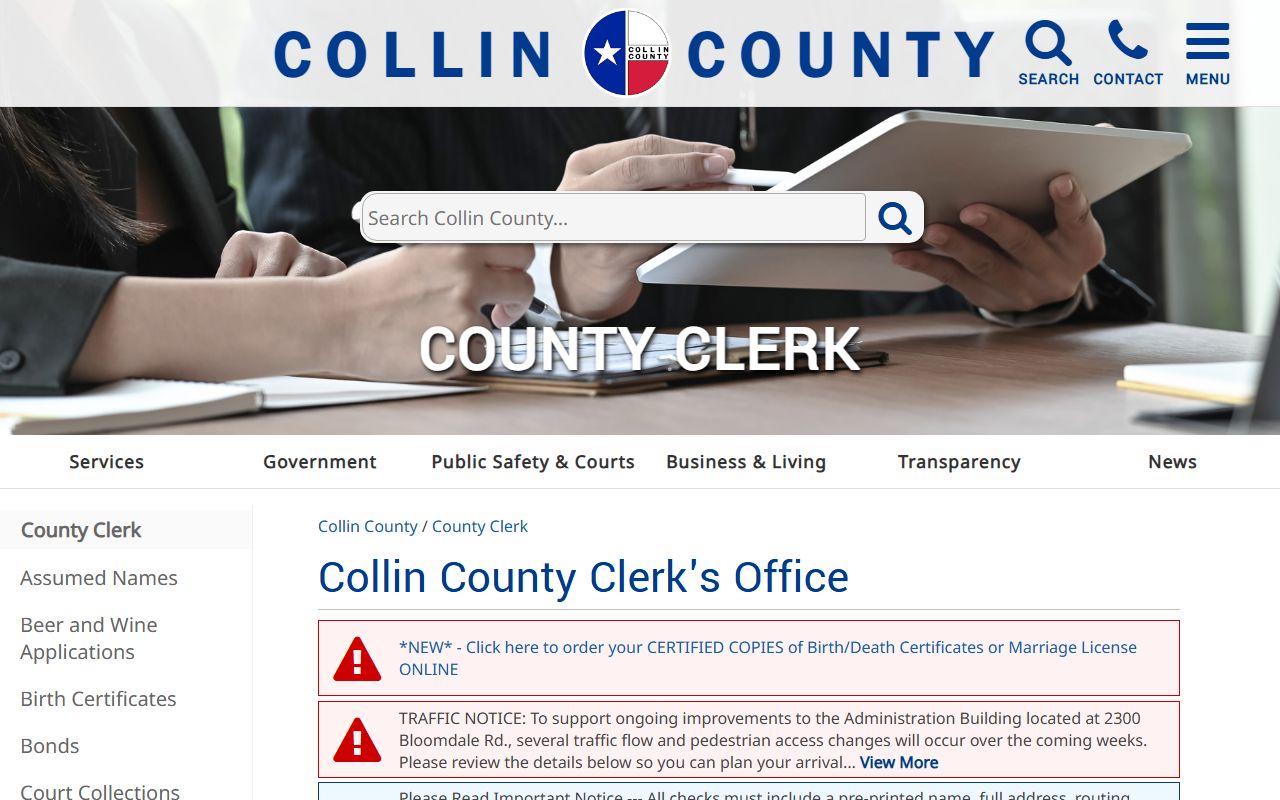
| Office | Collin County Clerk |
|---|---|
| Address | 2300 Bloomdale Rd, McKinney, TX 75071 |
| Hours | Monday through Friday, regular business hours |
| Website | collincountytx.gov/County-Clerk |
The online Official Public Records search lets you search by grantor or grantee name, document type, and date range. It covers records from 1846 to present. Document images are available to view and download. The clerk also records UCC filings and federal tax liens, which are searchable through the same system. Assumed name certificates (DBA) are filed here as well.
How to Search Collin County Records
The Collin County Clerk's online system is the most convenient way to search property records. Use grantor or grantee name to find deeds and liens associated with a person or business. You can also filter by document type or date range to narrow results. The system returns instrument numbers, recording dates, and party names, and document images are available to view online.
For searches going back to older records, the online system covers a broad date range, but some very early documents may require an in-person visit. When you visit the clerk's office in McKinney, public terminals are available for searching the index. Staff cannot search on your behalf, but they can guide you to the right resources. If you are conducting a full title search for a real estate transaction, a local title company or abstractor is the most reliable option. They have full access to the county index and can perform a thorough chain-of-title review.
Third-party services like TexasFile also index Collin County records and may be useful as a supplementary search tool, though the clerk's official system is always the authoritative source.
Note: Always confirm search results against the Collin County Appraisal District records to verify current ownership and property descriptions.
Types of Records in Collin County
The County Clerk records a wide range of instruments that affect real property in Collin County. Under Texas Property Code Section 12.001, instruments must be recorded to give legal notice to third parties. Each filed document gets an instrument number and is indexed by party name and document type.
Common property record types in Collin County include warranty deeds, special warranty deeds, quitclaim deeds, deeds of trust, deed of trust releases, mechanic's and materialman's liens, federal and state tax liens, lien releases, homeowners association liens, lis pendens notices, easements, right-of-way documents, plats and subdivision maps, and assumed name certificates. Subdivision plats are especially common given the amount of residential development in the county.
Plat maps show lot lines, street layouts, easements, and drainage areas for subdivisions. They are recorded when a developer subdivides land and are important reference documents for any property in a platted subdivision. Collin County has hundreds of active subdivisions, so the plat index is extensive.
Collin Central Appraisal District
The Collin Central Appraisal District maintains appraisal and ownership records for all taxable property in Collin County. The CAD database is separate from the County Clerk's deed records but is useful for identifying current owners, appraised values, exemptions, and property details. Chief Appraiser Bo Daffin oversees the office, and the board is appointed by taxing entities in the county.
You can search the CAD online by owner name, property address, account number, or legal description. Results show land and improvement values, exemptions applied, and the taxing entities that affect the property. Interactive maps show property boundaries and comparable sales in the area. If you disagree with your appraised value, you can file a protest online through the CAD portal. The protest deadline is May 15 or 30 days after your notice of appraised value.
The appraisal district also has an email notification service that can alert you to changes in your property's appraised value. This is useful for owners who want to track valuation changes from year to year without manually checking the CAD site each spring.
Note: CAD records may lag behind recent deed recordings by several months, so always check the County Clerk system for the most current ownership information.
Recording Fees and eRecording
Recording a document with the Collin County Clerk costs $26 for the first page. Each additional page is $4.00. For documents with more than five parties to be indexed, there is a charge of $0.25 per additional name over five. These fees are set by state law and apply uniformly.
Collin County accepts eRecording through authorized vendors, which is the fastest and most common method for title companies and lenders operating in the county. eRecording allows documents to be submitted and returned electronically, usually within the same business day. Major eRecording vendors like Simplifile and CSC work with the Collin County Clerk. For individual filers, in-person and mail submissions are also accepted. Mail submissions should include payment by check or money order made out to the County Clerk.
Certified copies cost $5.00 plus $1.00 per page. Plain copies are available for less. For most title research purposes, plain copies are sufficient. Request certified copies only when required for court filings or government agency submissions.
Texas Public Information Act
Collin County property records are public documents. Under Texas Government Code Chapter 552, the Public Information Act gives anyone the right to request government records without stating a reason. You don't need to own the property or be a party to the document to get access.
The clerk must respond promptly to record requests. If it will take more than ten business days to produce the records, the office must notify you of the expected timeline. Property records that are indexed and online are generally available right away. The Texas Attorney General's Open Government Division handles disputes about record access and publishes guidance for requestors.
Some content in property records is redacted from online images under Texas Property Code Section 11.008(k)(1-2). Social security numbers and financial account numbers are removed from online document scans. The complete original documents remain on file with the clerk.
Additional Property Resources for Collin County
The Texas Comptroller's Property Tax Assistance Division provides forms, exemption information, and protest guidance for property owners statewide. The Comptroller also conducts biennial property value studies for each school district, which affects school funding but does not directly change your local appraised value.
For historical land research, the Texas General Land Office maintains records of original land grants going back to Spanish and Mexican rule. Collin County land was part of the Peters Colony and other early Texas land grant programs, making the GLO database a valuable resource for deep historical research. The archive includes survey field notes and patent documents.
The Texas Secretary of State's SOSDirect system is useful for researching liens or encumbrances tied to business entities. UCC filings at the state level can affect property held by businesses and are searchable through the SOS system. The Texas State Law Library provides online research guides on Texas property law topics.
Nearby Counties
Collin County borders several counties in the Dallas-Fort Worth area. If a property is near a county line, confirm which county the address falls in before searching.